Understanding Crypto Intents: The Future of Your DeFi Trades
Ever made a crypto swap and felt like you needed a degree in blockchain engineering just to get it done? You're not alone! The world of decentralized finance (DeFi) is incredible, but sometimes, it can feel a bit... technical. That's where crypto intents come in.
Crypto intents (also known as blockchain intents) are a high-level abstraction for directing transaction outcomes in a blockchain network. Sounds fancy, right? In simple terms, intents make it easier for you, the trader, to direct your transactions, while also allowing the underlying network to be more efficient and secure.
Understanding intents isn't just about buzzwords; it lets you decide what kind of blockchain interaction is right for your trading projects, potentially saving you headaches, gas fees, and even protecting your trades. In this article we’ll tell you everything you need to know what crypto intents are, how they work and how they help you trade safely and securely.
What Are Intents in Crypto Trading?
At its core, a crypto intent is a blockchain interaction method where users specify their desired outcome (like "I want X token and I'm willing to pay up to Y") rather than explicitly detailing how the transaction should be executed.
Think of it this way:
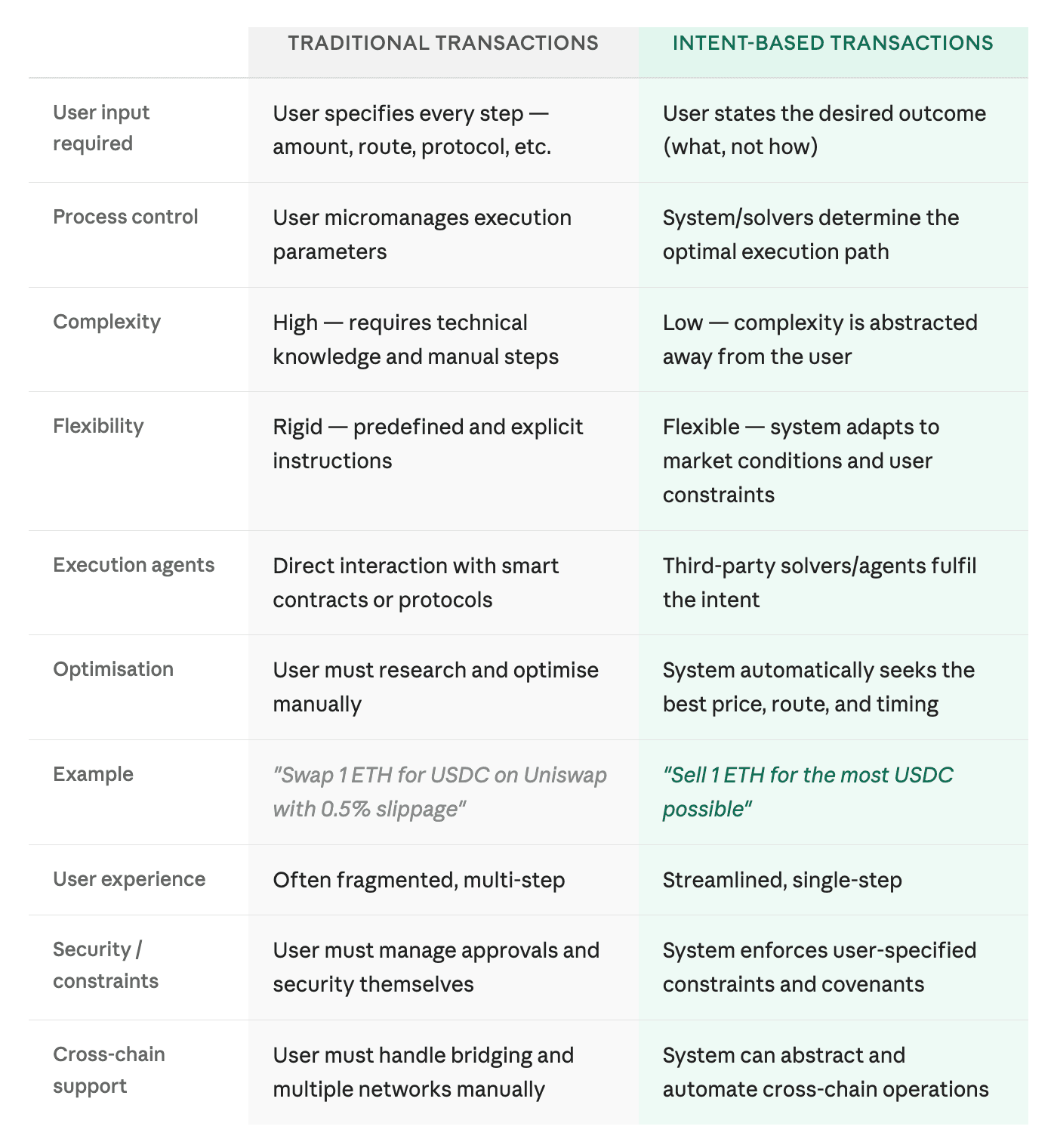
In a traditional "declarative" system (like many existing DEXes or even centralized exchanges), you have to tell the system exactly what to do: "Swap 1 ETH for USDC, use Uniswap V3, set slippage to 0.5%, and execute now." You're specifying every single detail of the trade.
With intents, you're taking a step back. You're saying, "Hey, here's what I want to achieve, and here are my constraints. You figure out the best way to make it happen." It's like telling a taxi driver your destination ("I want to go to the Eiffel Tower") instead of giving them turn-by-turn directions ("Turn left at this street, then right at that light, go straight for 2 miles..."). The driver (or the underlying system) handles the technical details of execution, navigating traffic and finding the most efficient route.
Intent-Based vs. Traditional, Transactional Trades
Let's break down the core difference between these two approaches:
In simple terms:
-
Traditional transaction: "Do A then B, pay exactly C to get X back." (You're the micromanager.)
-
Intent-based approach: "I want X and I'm willing to pay up to C." (You state your goal, the system finds the way.)
Here's a more detailed comparison:
The problem in DeFI Trading
DeFi promised an open financial system. What it delivered (at least in the early days) was a maze of clicks, approvals, and technical know-how that scared off all but the bravest traders.
Complexity
To execute even a simple trade, you had to manage each blockchain step yourself - from approving tokens, to setting gas, to handling slippage. Miss one setting, and you could lose money or stall a transaction. Without technical proficiency, most users were at a serious disadvantage, competing in a market stacked against them.
Inefficiency
When everyone trades in isolation, each person pursues their own best interest. That sounds fine - until you realize it leaves a lot of value on the table. Picture ten people each hailing their own taxi at once. With no coordination, they overpay, wait longer, and clog the street. In DeFi, this looks like fragmented liquidity and sub-optimal transaction sequences that could be executed far more efficiently if traders coordinated. Enter intents.
How Intents solve this
An intent flips the script. Instead of micromanaging the steps, traders simply declare the outcome they want: "I want 100 USDC on Arbitrum turned into ETH on Base." The protocol's backend then does the heavy lifting - aggregating all those intents, and computing the optimal sequence of blockchain transactions to make them real.
Here's why that matters:
-
Intents simplify trading by removing the need for technical transaction management.
-
Intents unlock efficiency by coordinating trades in bulk, finding routes and matches individual traders would miss.
-
Intents level the playing field by letting solvers compete to deliver the best possible execution on behalf of users.
The result? A trading system that feels more like setting a goal - and less like wrestling with a command line.
The Benefits of Intent-Based Trading
So why all the hype about intent-based exchanges? Because they solve some of DeFi's biggest headaches while opening doors to a healthier, more accessible market. Here's how:
-
Simplified crypto trading
With intents, trading stops feeling like programming a machine. Instead of juggling approvals, gas, and slippage settings, traders just set their goal through a clean UI. This makes DeFi accessible to more people - not just the technically fluent - and closes the skill gap that often separated "power users" from newcomers. -
More efficient exchanges
Solvers compete to find the best way to resolve sets of intents, which naturally drives efficiency. This creates a "solution market" where innovation thrives, routes improve, and traders get better prices. Intents also enable powerful coordination mechanisms like Coincidence of Wants - where two traders' opposite goals cancel out intermediaries entirely, cutting friction for both sides. -
Stronger exchange security
By batching trades, intent-based systems can shield users from predatory tactics like frontrunning and sandwich attacks. For example, CoW Protocol uses batching to deliver MEV protection, ensuring traders don't lose value to bots exploiting transaction order. Aligning incentives this way makes the exchange more stable over the long run - and builds a fairer environment for everyone. -
Standardization potential
Because intents operate at the "goal" level rather than the "transaction" level, they're more portable across protocols. Think of it like running one operating system on different hardware. This opens the door to a network of intent-driven DEXs and meta-DEXs, building out a robust but still decentralized trading ecosystem. -
Usability: Users only need to understand the simple intent syntax rather than coordinating entire, complex transaction chains. This levels the playing field between novice and advanced users, making sophisticated trading techniques more accessible to everyone.
-
Gasless Trading: Solvers submit transactions on users' behalf, with gas costs neatly factored into the price estimates. This means users pay gas fees with their sell token rather than requiring ETH (or the native chain token) upfront, eliminating the need to constantly top up your wallet just for transaction fees.
-
Execution: Specialized solvers compete fiercely to provide optimal execution across multiple venues and strategies. This results in better pricing than many traditional DEXes can offer, thanks to sophisticated routing and optimization that would be impossible to implement manually.
In short: intents don't just make trading easier. They make it smarter, safer, and more scalable.
How Intent-Based Architecture Works
Beyond just a trading protocol, intent-based architecture often provides a solving protocol. This means there are dedicated entities (those "solvers" we talked about) that build algorithms to resolve user intents into actual, on-chain transactions.
These systems can either have a built-in solver algorithm, or more commonly, offer a solver marketplace. In a marketplace, solvers compete to provide the most efficient solutions. Often, there's a baseline solution, and solvers are incentivized with a cut of the "surplus" or savings their solution generates. The solution that saves the most (e.g., on gas fees or by finding a better price) wins the bid for that cut.
Example
Let's look at an example of intent architecture in practice:
Suppose three traders express the following intents:
-
Trader A: Buy ETH with USDC
-
Trader B: Sell ETH for BTC
-
Trader C: Sell BTC for USDC
A traditional, declarative system would typically lead to a series of separate transactions. Trader A buys ETH, then Trader B sells ETH, then Trader C sells BTC, with each stage incurring gas fees and potential slippage.
Now, with an intent-based system, a solver observes these three intents in a batch. Instead of separate transactions, the solver proposes a three-way swap (or "ring trade") that rotates the tokens according to the agreed-upon prices: Trader A's USDC goes to Trader C, Trader C's BTC goes to Trader B, and Trader B's ETH goes to Trader A.
This clever swap drastically reduces the number of individual on-chain transactions involved in this overall exchange, saving on gas for everyone. If this is the winning solution in a marketplace, that solver gets a small cut of the gas savings they generated, rewarding their efficiency.
The state and future of crypto intents
Crypto intents aren't just a clever idea - they're quickly becoming the foundation for how the next generation of decentralized exchanges will work.
Standardization efforts
Right now, builders are laying down the groundwork for interoperability. Instead of each DEX inventing its own intent language, proposed standards are emerging to create common frameworks. This makes it easier for teams to build intent systems without reinventing the wheel - and for users to interact confidently across multiple platforms. In the long run, this builds a network of intent-powered DEXs that feel consistent, stable, and reliable.
Some of the most important standards taking shape include:
-
ERC-7683: a shared spec for cross-chain and cross-protocol intents.
-
ERC-7521: defining intent execution flows for secure settlement.
-
SUAVE intent format: a Flashbots proposal for running intents on their SUAVE chain.
Bridging DEXs with swap intents
One of the most exciting applications of intents is in cross-DEX swaps. Instead of being locked into a single exchange's liquidity, traders can declare an outcome - and let solvers coordinate the best path across multiple protocols. With CoW Swap, intent-based aggregation finds the most efficient routes, so users can access the full depth of liquidity in DeFi while still getting the best price.
Building the future of crypto
Taken together, intents represent a shift toward trading that is simpler, safer, and more efficient. By abstracting away complexity while preserving decentralization, intents strengthen the overall ecosystem. The endgame? A marketplace that's more open, trustworthy, and usable - not just for the technically fluent, but for everyone.
How CoW Swap uses intents
At CoW DAO, the mission is simple: make trading more secure, open, and user-friendly. CoW Protocol's intent-based design powers CoW Swap, a DEX aggregator that not only finds the best prices across exchanges but also unlocks a powerful efficiency: the Coincidence of Wants (yes, the "CoW" in CoW Swap).
CoW Swap leverages the powerful intent-based architecture of CoW Protocol. When you decide to make a swap on CoW Swap, you're not directly executing a transaction on-chain in the traditional sense - meaning you're not broadcasting a public transaction that an MEV bot could front-run. Instead, you're engaging with an intent-based system, which truly elevates your trading experience.
Here's a closer look at what happens behind the scenes when you submit an order on CoW Swap:
-
Signing an Off-Chain Message (Your Intent, Your Control):Instead of constructing a complex on-chain transaction that dictates every step, you simply sign an off-chain message. This message is your intent. It clearly indicates your desired trade, specifying parameters like the tokens you want to swap, the amounts, and any limits (like a minimum amount you're willing to receive). This signing process is gasless and doesn't directly interact with the blockchain's mempool, giving you a crucial layer of privacy and protection from the get-go. Your wallet will prompt you to sign this "intent to trade" message, giving you full transparency over what you're approving.
-
Solvers Compete for Optimal Execution (The "How" is Handled for You): Once your signed intent is submitted, it enters an off-chain order book managed by the CoW Protocol. This is where the magic really begins. Your intent is grouped with many others into "batches" that are then presented to a network of specialized entities called "solvers." These solvers are sophisticated algorithms, often run by professional market makers, who compete fiercely to find the absolute best way to fulfill all the intents within a given batch. More recently we have built a new system that allows solvers to solve parts of batches. But for now, this is in essence how it works. Their job is incredibly complex: they scan all available liquidity sources - this includes every major on-chain DEX (like Uniswap, Balancer, Curve, etc., similar to how a DEX aggregator works) and private liquidity from their own inventories or centralized exchanges. They're not just looking for the cheapest direct route; they're looking for the most efficient combination of routes, including:
-
Coincidence of Wants (CoW): This is CoW Swap's secret sauce. If, within the batch, another user has an opposite intent (e.g., you want to buy ETH with USDC, and someone else wants to sell ETH for USDC), the solvers will try to match you directly, peer-to-peer. This bypasses external liquidity pools entirely, eliminating AMM fees and often resulting in incredibly favorable prices and significantly lower gas costs because the trade requires fewer on-chain interactions.
-
Ring Trades: Sometimes, three or more users' intents can be rotated in a loop (like our earlier example of USDC to ETH, ETH to BTC, BTC to USDC). Solvers are adept at finding these multi-party CoWs, further optimizing gas and price for everyone involved.
- Benefiting from Improved Pricing and MEV Protection (Your Trade, Reimagined): The solver competition is designed to maximize "surplus" for the users - essentially, to find the best possible price for your trade. The solver that can achieve the highest surplus across the entire batch wins the right to execute the trades on-chain. This competitive environment incentivizes them to constantly innovate and find better routes.
Crucially, this batch auction mechanism, combined with off-chain intent signing and Uniform Clearing Prices (where all trades of the same asset pair within a batch settle at the same price), provides robust MEV protection. Because your order isn't sitting in a public mempool waiting to be exploited, and because solvers absorb any MEV risk themselves, you're shielded from harmful front-running and sandwich attacks.
This entire process means a simpler, safer, and often more cost-effective way to swap your crypto. You tell CoW Swap what you want - your desired outcome - and the protocol, powered by its network of competing solvers, works tirelessly behind the scenes to deliver the best possible outcome for you, all while abstracting away the complex execution details and keeping your trade protected. It's truly a smarter way to trade in DeFi.
Next Steps
Ready to experience the power of intents for yourself? Head over to CoW Swap and try a trade!
Related Reading: